
Why the fad of green roofs has faded and what comes next
Hi readers,
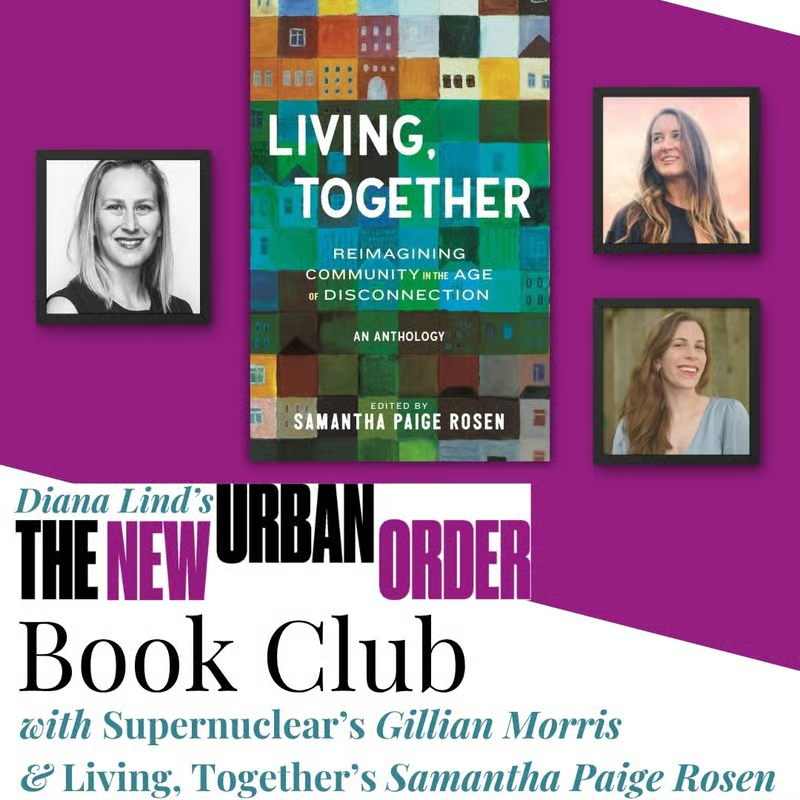
Today at 6pm ET I’ll be joining and to talk about Rosen’s book Living, Together: Reimagining Community in the Age of Disconnection. Join us and more info here.
Today’s post features an email back-and-forth with , author of the publication . Enjoy the conversation below and the job listings at the end of the post. If this kind of content interests you, consider subscribing or upgrading to paid!
Diana Lind: The Philadelphia’s 76ers just shared first some renderings of their proposed new stadium in South Philadelphia.
When I saw the design, it made me think of the Barclays Center in downtown Brooklyn. (The 76ers stadium is supposed to remind people of Philadelphia’s old Spectrum stadium, but since I’m a native New Yorker, that’s what happened.)
But the Barclays Center is a product of its time — 2004 design, 2012 construction — and has a green roof on top. This new stadium does not. It prompted a thought I’ve occasionally had: I think we’re done with green roofs. You rarely ever see them as part of new designs anymore. Are green roofs over?
Lloyd Alter: To paraphrase Mark Twain, the reports of their deaths have been greatly exaggerated. For example, the new Lucas Museum of Narrative Art by Ma Yansong is covered in one.

However, they certainly are not all the rage like they used to be. The Barclays Center is an extreme example of the problem: They built a massive truss over the existing building and covered it with an extensive (light weight) sedum green roof, to help market the apartments looking over it (the white roof was really ugly) and muffle sound from the area. I wrote at the time (when we were just learning about embodied energy, later to be known as embodied carbon)
They are essentially building a bridge to hold up a “flocked” pattern of sedum trays. The carbon footprint and embodied energy of so much steel far outweighs the environmental benefits of any green roof, let alone this one. The whole thing, from start to finish is a multimillion dollar environmental negative.
Diana Lind: One of the big reasons I think green roofs were so popular 15 years ago is that there were once strict EPA regulations and lawsuits against cities to address stormwater runoff in the early 2000s. That concern over what happens to rainwater and how to address outdated sewer systems encouraged public and private development to include green roofs. Those regulations are now gone and so there’s no regulatory incentive anymore.
I also wonder if green roofs were once more fashionable as a physical symbol of a commitment to sustainability. The need or desire to prove how green you are has declined a lot over the past decade. Do you think that companies and governments no longer need to demonstrate their eco-cred?
Lloyd Alter: Green roofs were seen as ways to reduce heat island effects and provide bird and bee habitats, and as an employee benefit on a corporate campus. But one of the main uses of them was for greenwashing during the approval stage.
One never used to see renderings of buildings from above, because all you would see was a roof and mechanical equipment. But once green roofs were possible, you could sell an obnoxious building by putting a green roof on it and doing the rendering from above, so you could barely see the building.
One of the first and most egregious examples of this was in Singapore, where Kenzo Tange designed the master plan of the Nayang Technological University campus with a park in the middle that was the “green lung” of the campus.

To put a building in the green lung, they put a green roof on it and made it ramp down to grade, making it, as I wrote in 2009:
a non-building building, as CPG director Hoong Bee Lok puts it, that would allow it to build on the central green space without taking away from it. So if you want to put a building in a park, wrap it in grass.
I considered it to be dangerous trend and called it “greenwrapping.” I wrote an article (long deleted at treehugger, but somehow stolen by Inhabitat where I just found it) noting:
At some point a few of these are going to get built, and people are going to realise that green roofs are being used as the new equivalent of mirrored glass; Architects used to show renderings of towers reflecting birds and clouds to somehow make it disappear and be more palatable to residents and planning officials. In the end, people got a big box covered in mirrors. We should be careful that we don’t get sold a whole lot of big boxes with green boxtops, always shown from above. When you are at street level it will be a very different picture.
Diana Lind: At the same time, maybe the state of the commercial real estate killed green roofs. Green roofs have always been expensive to create and expensive to maintain. When the pro forma for commercial real estate is becoming harder to pencil, who wants to add a green roof as a budget line? No one.
Lloyd Alter: The two strikes against them are the weight, which means more structure and more upfront carbon emissions, which many jurisdictions are beginning to consider seriously, and the competition for rooftop real estate with solar panels.
And of course, the rolling back of any environmental regulations. This is not just in the USA; in Toronto, there was a strong green roof bylaw, and the Trumpy premier of the province just outlawed green bylaws that were tougher than the province’s rules, saying it added cost and confusion.
Yet even the dopey new Science Centre that he is building on the waterfront (after stealing the real estate from the existing science centre) shows green roofs and solar panels.

Diana Lind: Maybe the future of green roofs is in residential properties. I just read a piece in the New York Times this past weekend showing a homeowner that built a green roof on her garage mostly for the aesthetic value.

The small green roof might be the appropriate scale for a personal commitment to sustainability or enjoyment of green space. As companies and governments focus on addressing climate change, they are looking at a much, much bigger scale than, say, 10,000 square feet of green roof. For example, how many green roofs would match the environmental impact of data centers? When you think on that scale, you realize how inadequate a solution green roofs are.
Lloyd Alter: I believe the future is food.
The roof of the building where I taught last year has a rooftop farm which feeds the students downstairs. As the climate crisis worsens, we have to shorten our food chain. We could turn the roofs of our buildings into allotment gardens or larger commercial farms. In World War II, parks and yards were turned into victory gardens; in the climate war, we could build victory roofs.
Jobs From My LinkedIn
Program Director, Innovation Fellows Initiative – Cornell Tech
Communications and Engagement Lead – Canadian Association for the Practice of Architecture
BCPI Director, Civic Engagement (Bloomberg Center for Public Innovation)
Senior Manager, Strategic Program Evaluation (Bloomberg Center for Public Innovation)
Strategy and Change Management Officer – City of Portland
CEO – James Barry-Robinson Institute
Program Associate, GBA-ASEAN Initiative (GAI), Climate & Energy (C&E)
Deputy Director, Multifamily Housing and Homeownership Programs – 0904-Mayoral Staff XVI
Managing Director, Strategy and Community Impact – Greater Washington Community Foundation
Director of Community Capital Investments – LISC